Discover/Onboard an ADC Device
Onboard the supported ADC vendor devices (Hardware, Cloud, and Software) into the AppViewX inventory using the IP Address/FQDN. AppViewX will initiate the communication using the provided credentials and Discover the Applications/Objects along with their configuration that are hosted on the devices. The Discovered Applications can be accessed within the product.
For vendor-specific device addition, refer to Discover/Onboard ADC Device for Vendor.
To onboard a device into Device Inventory,
-
Go to
 Menu > ADC+ > ASSET MANAGEMENT > Device
Inventory.
By default, the ADC tab opens.
Menu > ADC+ > ASSET MANAGEMENT > Device
Inventory.
By default, the ADC tab opens. -
In the ADC tab, click add
 button located upper right corner.
The Add page appears. -
Enter or select the field information in the General Information
section.
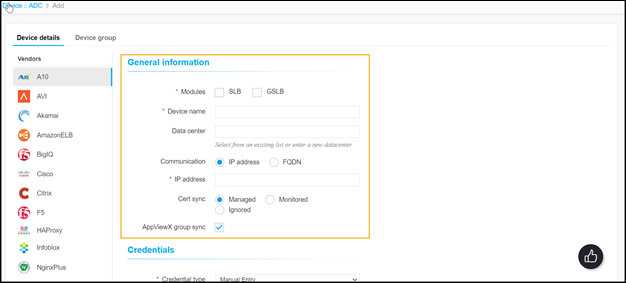
The following table provides the field description for adding ADC device details in the General Information page:Field Description *Modules Select one of the following or both for ADC device in AppViewX:
- GSLB - Global Server Load Balancing is the process of distributing application traffic among a large number of connected servers available across the world at multiple geographic locations.
- SLB - Server load balancing distributes traffic locally from GSLBs to appropriate servers to ensure consistent, high-performance application delivery.
Based on this module selection, the respective configuration of the device will be fetched into AppViewX.
*Device name Unique custom identifier of your device. Data center The data center on which the device has been hosted. Select a Datacenter from the drop-down list or enter a data center name. Communication The communication mode that ADC devices can be added to AppViewX. The possible communication modes are:
- IP Address - The IP Address can be IPV4 and it can be either management IP or Self IP of the ADC device. By default, the IP address has been selected.
- FQDN - On adding the device with FQDN, it will be resolved to an IP address and communication to the device will be made through it. If the FQDN is resolved to more than one device IP, AppViewX will choose a random IP for communication.
- Port - A custom-enabled port of the Device, through which the communication will happen from AppViewX.
*IP address/FQDN Enter the IP address or FQDN based on the selected communication mode. Cert sync Provision to discover and manage the SSL certificates from the ADC devices. The possible Cert syncs are: - Managed - All SSL certificates will be discovered and added to AppViewX certificate inventory and used for certificate lifecycle management like renew, revoke, etc.
- Monitored - All SSL certificates will be discovered and will not have any CA-related communication.
- Ignored - No SSL certificates will be discovered from the ADC device.
AppViewX group sync Select this checkbox to enable the group sync. AppViewX Group Sync ensures configurations are in sync between active/primary and secondary/failover devices. This sync interval can be configured at AppViewX's SETTINGS page. Note: The asterisk (*) symbol indicates mandatory fields. -
Enter or select the field information in the Credentials section:
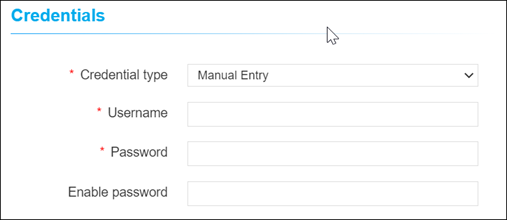
The following table provides the field description for adding ADC device details in the Credentials page:Field Description *Credential type Credentials can be manually provided or stored as a one-time entry onto the credential library and referred at the time of device addition. Select one of the following credential types from the drop-down list: - Manual Entry - The user name and password of the device need to be entered with device details. By default, the Manual Entry option is selected.
-
AppViewX Credential List - The user name and password can be added to the List and that entry can be referred to during device addition.
To create a credential list, see Creating Credential List in the Platform User Guide.
*Username Username for the ADC device when you select the Manual Entry credential type. *Password Valid password for the ADC device when you select the Manual Entry credential type. Note: Use strong passwords for secure device communication. Your Passwords can be of any length with a combination of alpha-numerical, symbols, and special characters.Enable password For the AppViewX Credential List credential type, select your credential list with a CYBERARK username and app ID from the dropdown list. Note: The asterisk (*) symbol indicates mandatory fields. -
Enter or select the field information in the Secondary device
information section as follows:
-
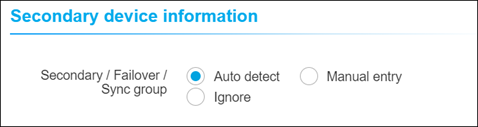
Auto-Detect - This option will automatically detect the corresponding secondary devices and add it as a new entry into AppViewX inventory using the Primary device’s credential.
-
Manual Entry - This selection will enable you to manually add Secondary devices with a Sync-group name entered for reference. This name will be used to identify the pairs in the inventory. Follow similar steps.
-
Ignore - This option can be enabled if you need to ignore the detection of the secondary device associated with the current device.
Note:-
In a typical network configuration, Application traffic will be handled by multiple ADC devices for ensuring the high availability of the application. This distribution of ADC servers will be meaningful during any disaster recovery and avoid a single point of failure. To achieve this, multiple ADC devices will be configured in Active/Standby or in failover groups. In this grouping, one ADC device will be serving the traffic and the rest of the devices in the group will act as a backup in case of a failure. The configuration will be in sync between these devices. At the same time, devices in a sync group can be in active-active mode also. You can manage one or more such Secondary devices (Failover/Standby devices) in inventory.
- By clicking the Add button, multiple devices can be added as secondary devices and all the devices will be available in the grid.
- By managing the Primary and Secondary devices in AppViewX during the device flips, traffic routing and management can be seamlessly handled in AppViewX.
-
-
Click the Save button to add an ADC device.
Note:
- To discard the changes, click the Cancel button. Note: Repeat the same steps to add more ADC device(s).
- Repeatt tthe same stteps tto add morre ADC devviice(s).