Client Certificate Authentication
SSL/TLS certificates are commonly used for both encryption and identification of the parties. Client Certificate Authentication is mutual certificate-based authentication, where the client provides its Client Certificate to the Server to prove its identity. This happens as a part of the SSL Handshake (it is optional).
Client Certificate is a digital certificate that confirms to the X.509 system. It is used
by client systems to prove their identity to the remote server. Here is a simple way to
identify where a certificate is a client certificate or not: 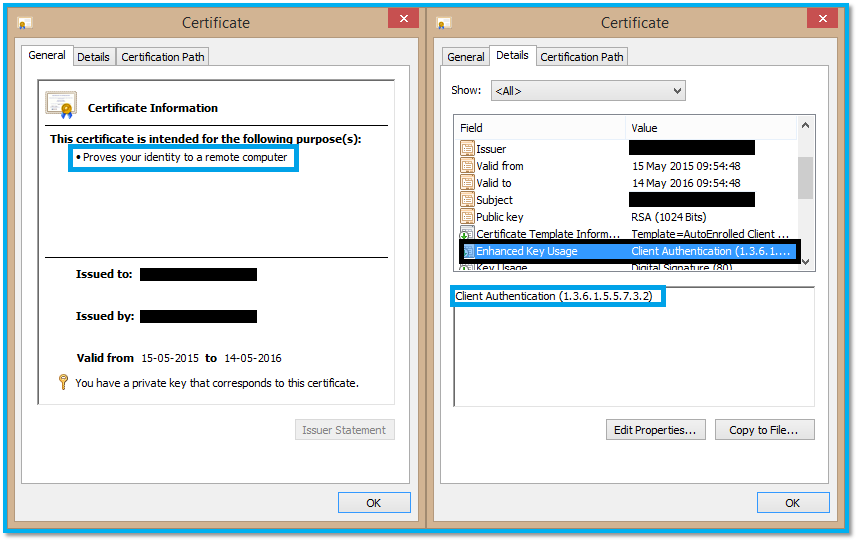 Client authentication certificates include some
or all of the following info:
Client authentication certificates include some
or all of the following info:
-
In the Details tab, the certificates intended purpose has the following text: Proves your identity to a remote computer
-
Verify that the Enhanced Key Usage field of the certificate has the OID set to (1.3.6.1.5.5.7.3.2).
- SSL version number, certificate's serial number, and other information that represents the certificate.
- CA name
- Client name
- Certificate validity (expiration date of the certificate).
- Public and private key pairs.
- Additional info, based on the x.509 certificate version.
- CA's digital signature.