Configuring the RADIUS Configuration
AppViewX integrates with RADIUS for authentication of external users.
To configure the RADIUS authentication:
-
To access the navigation pane, in the top-left corner of the screen, hover the
mouse pointer over the
 icon.
icon.
-
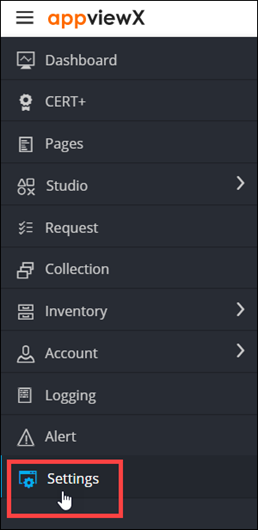
From the menu displayed, click Settings.
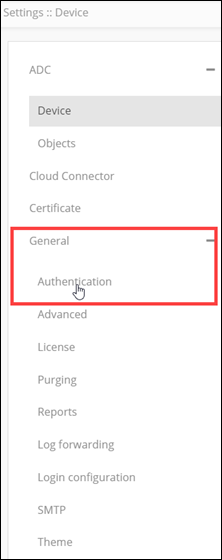
- On the Settings page, from the navigation pane on the left, click General.
-
Under General settings, click
Authentication.
The Settings :: Authentication page is displayed, with the LDAP tab open by default.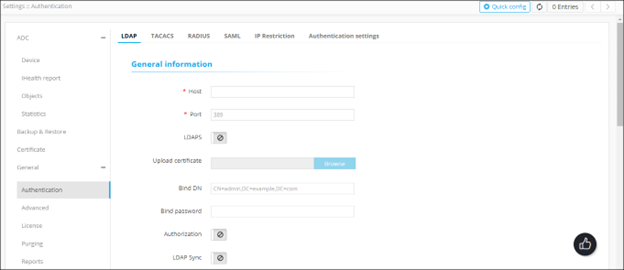
-
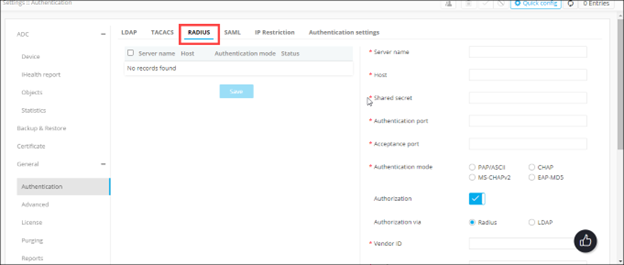
To configure the RADIUS authentication settings, on the Settings::
Authentication page, click the RADIUS
tab.
-
Enter the following details (sample values are shown in the image below the
table):
Field Description *Server name Name of the RADIUS server. *Host The IP address of the RADIUS server. *Shared secret A unique key for authentication between the AppViewX server and the RADIUS server. *Authentication port Port number that AppViewX will use for authentication. Note: The default authentication port number is 1812. Please check with your sysadmin if your organization uses a different port number.*Acceptance port Port number that AppViewX will use to accept a response from the RADIUS server. Note: The default acceptance port number is 1813. Please check with your sysadmin if your organization uses a different port number.*Authentication mode Select one of the following authentication modes: - PAP/ASCII
- CHAP
- MS-CHAPv2
- EAP-MD5
Note: Ensure that the selected authentication mode is also confirmed in the RADIUS server settings.*Authorization In addition to authentication, AppViewX also lets you perform user authorization against the RADIUS server. To enable authorization along with authentication, turn on the toggle.
Note: If Authorization is not enabled, AppViewX will only carry out RADIUS authentication for the given user.*Authorization via Select from one of the following authorization modes: - RADIUS: To perform both, authentication and authorization, via the RADIUS server
- LDAP: To perform authentication via the RADIUS server and authorization via the LDAP server
Note: This field is enabled only when the Authentication toggle is turned on.*Vendor ID Enter the vendor ID. Note: AppViewX does not have a unique vendor ID. We use a free vendor ID: 500. Ensure that this is configured as part of the RADIUS server settings.Note: This field is enabled only when the Authentication toggle is turned on and authorization is done via the RADIUS server.*Vendor type Enter the vendor type. Note: AppViewX does not have a unique vendor type. We use a free vendor ID: 200. Ensure that this is configured as part of the RADIUS server settings.Note: This field is enabled only when the Authentication toggle is turned on and authorization is done via the RADIUS server.*LDAP From the drop-down menu, select the LDAP server to be used for the authorization. Note: This field is enabled only when the Authentication toggle is turned on and authorization is done via the LDAP server.All * marked fields are mandatory. 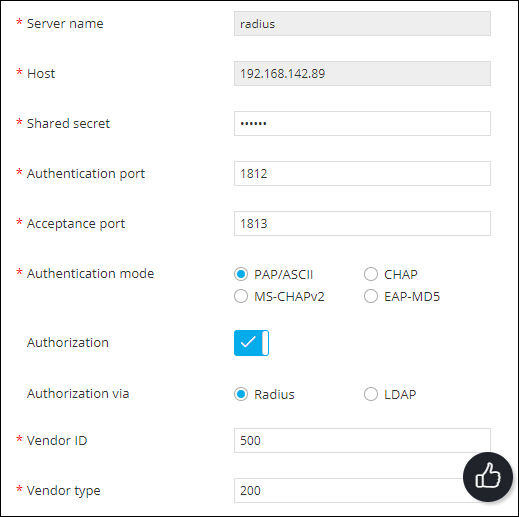
-
To save the RADIUS authentication settings entered above, click Add or
to reconfigure the settings, click Reset.
The RADIUS authentication settings thus configured are saved and displayed in the table shown in the left half of the screen:
 Note: In the case of multiple RADIUS servers, to define/update the order in which the servers will be authenticated, drag and drop the entries in this table.